
All blogs
How I built a hugely successful partner program and you can too (In-depth)
A hands-on example of how a reseller channel partner program helped Sweden-based Appland sign-on over 100 of the world’s biggest telecom operators as its customers.

In 2015, mobile distribution app platform Appland had around 10 B2B customers. Three years later, the Sweden-based company had signed on over 100 of the world’s biggest telecom operators as its customers. And then in October 2018, Appland was acquired by global mobile value-added services company OnMobile in a cash deal that was estimated to be worth around $15 million.
Q: How did this happen?
A: Because of Appland’s hugely successful channel partner program.
In one of my earlier blogs, I had explained how you can build your own reseller channel partner program in just 14 steps.
I’m now going to give you a concrete example of how I built Appland’s transformational channel partner program from scratch starting 2015, when I was the company’s Chief Commercial Officer, a post that I held until I resigned from the company in 2019.
The channel partner program I built was so successful that over the next three-and-a-half years, Appland recruited over 30 partners from all over the world who were instrumental in signing on its over 100 B2B customers.
If you want to know how to design a similarly successful channel partner program stay with me.

Before we start, let me briefly explain what exactly is a channel partner program.
A partner program is a strategy to motivate and engage partners to create more value for your end users.
Partners can create different types of value. These include:
- Technical Partner – Adds new features and functions in your solution. Think of the Apple App Store where tech partners add new cool features and abilities to Apple’s hardware.
- Reseller channel partner – A local presence who can conduct physical visits and offer local support. These are useful especially if you are a company who wants to establish yourself in a new country but want to lower the risk. The local reseller helps you introduce your solution to the market.
- System Integrators and Consultants – Create a full solution where your solution is a part. For example, a company that helps another company to implement a new CRM (customer relationship management) system that is uniquely modified.
Some of the world’s biggest tech companies use channel partner programs – Microsoft, VMWare, Oracle and eBay are just a few of them.
In my opinion, channel partner programs are an extremely useful way to expand into new markets if you have a mature (proven in battle) product or solution.
But what everyone should know about creating channel partner programs is that it takes time and effort. For it to be successful, the company’s top leadership must be committed to the project. This is because you will need to heavily invest time and other resources in your channel partner and you won’t know if that investment has paid off until nearly a year later.
Any good channel partner program must be designed to ensure that your partner is on the same page as you. This will ensure it will be successful, boosting your sales, which is one of the objectives of the entire exercise (besides providing value to the B2B customer and the end user).
This is why all channel partner programs I have created so far – including the one for Appland – include detailed sales and marketing resources for partners. I have virtually hand held partners through the entire sales process so that there was absolutely no scope for any confusion.
This blog focuses on how I created a hugely successful partner program for Appland, so I’ll get to that point now. But if you want to know in detail how to build your own channel partner program, read my very popular blog: The 14 Steps to Build Your Reseller Channel Partner Program. (You can also read it later as I’ve added another link at the end of this blog.)
The story of Appland

Back in 2015, Appland was listed in Red Herring's Top 100 Europe, a prestigious award that celebrates the most promising private companies in Europe. Its website says companies that are selected for the award are “positioned to grow at an explosive rate”.
They weren’t wrong about Appland.
Appland was at the cusp of something big at that time because it had designed a truly unique solution. It offered an ad-free subscription model for high-quality mobile phone games, which addressed a problem that perhaps only one other company had addressed properly before (there were other low-quality versions of the concept, of course). Appland’s differentiator was that it offered a high quality service with some of the best games available.
FUN FACT: Tech giants Apple and Google introduced a similar games subscription model only in September 2019, a full four years after Appland had developed its model and was trying to figure out how it could be marketed worldwide.
The end user market for the solution was huge too.
Consider this. In 2015, over 1.9 billion people and children worldwide played mobile games, which were responsible for 82% of global app revenue.
These 1.9 billion people were all Appland’s potential end users. Their mobile phone operators were Appland’s potential customers. The question was: How did Appland reach them?
At that time, Appland had about 15 employees. Like any other start-up, it had a great solution but lacked the resources – money, employees and time – to be able to sell that solution to telecom operators all over the world who would take it to Appland’s end users.
That was when I came up with the idea to find resellers and local channel partners to help Appland with sales.
How I created the Appland channel partner program in 4 steps
Step 1: We need to talk about the customer
If there is one thing I have learned over the many years I have worked as a Growth, Sales, Marketing and Digitisation Strategist, it is this: Most companies know NOTHING about their customers – be it their B2B customers or their end users.
To design a super successful channel partner program, a company must first understand every aspect of all its customers. I did exactly this for Appland’s channel partner program.
I identified who its ideal customers were and used the Value Proposition Canvas from Strategyzer to create detailed profiles of each of them.
Appland’s customers were of three kinds:
- Channel partner: Who would take Appland’s high revenue services to telecom companies.
- Telecom company: Who would launch high revenue services to their customers.
- End user: People who would pay for these services. These were:
- Gamers for Appland’s Games Subscription Clubs.
- Parents for Appland’s Kids Subscription Clubs.
To understand all three of them, I conducted detailed analysis by:
- Talking to a lot of prospective B2B customers and potential channel partners.
- Reading up all kinds of reports about gamers to better understand them.
- I also studied gamification and used this knowledge to summarize why people play games and what motivates them.
I then created detailed user profiles, which defined the following:
- Jobs to be done, pains, gains.
- The purchase process.
- Competitors and alternatives.
- Buyer persona.
Here are some things I found while putting together these detailed profiles.
- Channel partners: Potential channel partners specialized in setting up business deals with mobile network operators and used the customer base of these operators to launch and sell their services. Because of this they were constantly looking for new services to be launched. What they wanted most was to create business deals with high revenue outcomes.
- Telecom companies: Most of these companies were getting less and less revenue from data and speech. They had a large customer base and what they wanted the most was to add new services to increase revenue streams and create customer stickiness.
- End users: Most casual gamers played mobile games when they were in transit, when they were waiting or when they wanted to relax. These gamers wanted quality entertainment. Their pain point was the irritants of pop-up ads, being nagged to buy coins and berries for $5, and malware or viruses that caused their games or phones to crash. What they wanted the most was to simply have fun playing their high quality mobile games uninterrupted.

Similarly, many parents worldwide gave their children mobile phones to entertain themselves so that they can get a breather (they still do). Their pain point was that they were often conflicted about this – they wanted the best for their children, but they also wanted to be able to go to the bathroom without their kids banging on the door every 15 seconds. What they wanted the most was the ability to switch off from their kids for 30 minutes without the associated guilt.
Appland already had the solution to all these “wants”.
Its subscription clubs would bring in regular revenue for its channel partners and telecom customers. And for the end users, just as you have Netflix for ad-free, high quality movies and Spotify for ad-free, high quality music, Appland offered subscription clubs for ad-free, high quality and fun games for casual gamers, and apps that focused on developing play and learning for the children of parents who wanted some free time.
All this information helped me draw up a strategy for how Appland should act and position itself to attract channel partners, telecom customers and end users.
Step 2: Created a kick-ass sales presentation
I then created a super good sales presentation (even if I say so myself).
I created about 45 iterations of it, spending 10,000 USD in all to design it (including the iterations). This process was essential as it ensured that every word and slide was tailored to create a specific feeling and message that was a good fit for all our customers.
The sales presentation served two purposes:
- I used it to convince channel partners that the products we offered were amazing and really well done.
- Channel partners used it to convince telcos to sign up for the solution.
In my presentation, I made sure to deliver a story of a cool product that no one else offered. I conveyed that Appland had great content and that everything it offered was of super high quality.

Step 3: I redesigned Appland’s website to target the customer profiles I created
Who wants to trawl through a super-slow website that looks like it has been designed in the last century and takes ages to load? No one.
If your website is anything like that… fix it NOW.
We made sure that Appland’s new website evoked the same sense that our presentations evoked: of being high quality and fun.
We also made sure that all headlines and text on the website addressed exactly what ALL our customers were looking for, and we spent a lot of time to add text and blog articles that focused on keywords that we selected for SEO.

STEP 4: I designed details of the channel partner program
My strategy was to give our channel partners all the tools that an internal sales person would have so that they could assist Appland in delivering value to all its customers.
These resources were of two kinds: pre-sales tools and post-sales tools.
Pre-sales tools included step-by-step sales resources such as presentations and training videos that would allow partners to deliver a polished pitch to the mobile network operators. The tools were designed to enable partners to easily convince these companies to move on to signing a contract.


Post-sales tools were for after the channel partner signed a contract with the telco customer and we started working together to deliver value to them. These tools focused on helping our partners deliver a good product that would be extremely successful.

Special tip for your own channel partner program
If you are planning to build your own channel partner program make sure that you really work hard to build amazing tools for your channel partners.
Just so you get an idea of the effort it took me to create pre-sales tools for Appland, here are some details:
- I created over 80 slides in the standard sales presentation that could be used to answer any questions the telco customer may have. I also created educational videos to help channel partners train themselves to sell, and I created special sales material directed at different issues that might come up during the sales process.
- For post-sales material, I created hundreds of slides and documentation explaining how the partner could be successful. For instance, one of them was a 70-slide long presentation on how to be successful in marketing.
You can also taste success if you put in BIG effort for your own channel partner program.
Sale first, partner agreement later
During the partner recruitment process I decided NOT to start with a detailed partner agreement. Instead my process was to sign such an agreement with the partner only when they were close to finalising their first deal with the telco customer.
This was the typical process I followed:
- Held web meetings with prospective channel partners where I held my own sales presentation and WOWed them.
- After the meeting, I sent them an email with a PDF of the presentation, demo of our service, information about our partner program, our non-disclosure agreement, links to some nice blog articles, customer success stories and a request for them to review all material.
- I also encouraged them to test our solution. This was via a special demo that they could download onto their phones and then test to install games and play them.
- If they expressed an interest in partnering with us, they registered their deals with Appland, and we both signed a mutual non-disclosure agreement at that point.
- We then pushed them to go out and test sell and pitch.
- I followed up and helped the best way I could. Sometimes I went on sales tours where I met channel partners and helped them pitch to prospects. This is a good way to meet interesting prospects and also establish deeper relationships with partners and their sales staff.
- As soon as we were nearly closing our first deal with the telecom customer, we (Appland and the partner) signed a formal partner reseller agreement with each other. The reason for signing the deal so late in the process was to ensure that we got into sales pitching much faster. This was great because once there was a hot deal on the table, the partner agreement between Appland and the partner could be closed swiftly.
The visible outcomes of Appland’s channel partner program
In just three-and-a-half years, Appland was able to build a global partner network and launched their value-added services in over 40 countries including Oman, Nigeria, Indonesia, Myanmar, Poland, Mexico and Panama.
Thanks to its local partnerships, the company was able to reach markets in places never imagined. All launches were done with local language and local marketing because of our local channel partners. This ensured that as many end consumers as possible were excited about the service and signed up for it with the telecom company that our channel partners were working with.
There was another remarkable fact about the whole program: We managed to convince our partners to pay Appland $20,000 each in a recoupable fee when they signed on their first mobile network operator.
In doing so, the local partner demonstrated that they were serious about the opportunity and were committed to invest in marketing, selling Appland’s solution, and managing the relationship with the local mobile network operator.
Once we received the payment from the partner, we integrated them into Appland’s platform and they subsequently integrated with the mobile operator's mobile billing solution. They would then launch different types of marketing campaigns to get end consumers to subscribe to the service.
When the service was launched, end consumers subscribed to it and revenue was collected. According to the agreement between Appland and the partner, all subscription revenue would be shared by the telecom operator, partner, and Appland. The local partner could then recoup the $20,000 they had paid to Appland at the beginning.
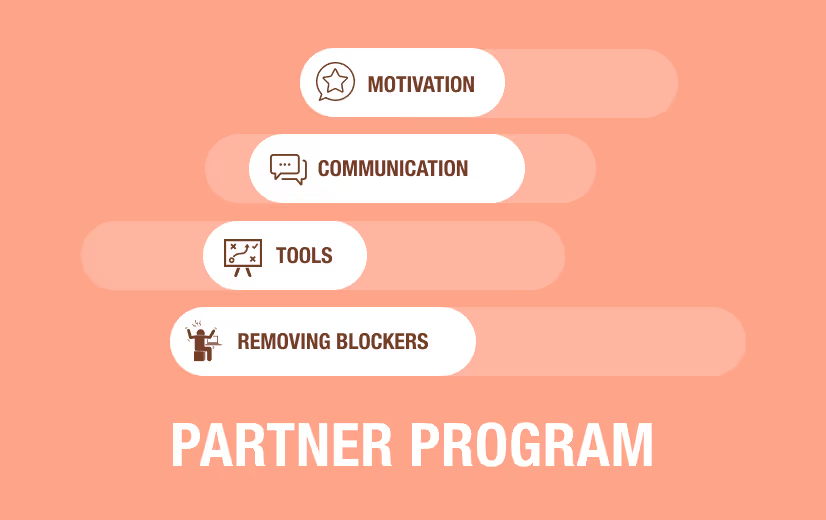
Channel partner programs: Four critical elements of success

While working so closely with this whole process, I concluded that four core elements would determine the success of any channel partner program. It is super important to get these right.
- Motivation of channel partners: No matter the type of partner, you need to identify what will motivate them. Remember that money is not always a core motivator. To belong to a community, build something cool or even the ability to be able to sell other value-added services along with Appland’s solution were good examples of other motivators in this case.
- Clear and direct communication: The ability to be able to communicate clearly is generally an important skill to have. With partners it is extra important. You are always competing with other things that can catch the partner’s energy and time. Make sure that everything you say and do is extremely clear. This includes all types of information such as sales training, information about features and functions, information about implementation. Yes, everything.
- Tools to close deals: The channel partner needs to have access to the same resources as your sales team. Make sure that you create detailed sales tools such as presentations, articles, documents and videos that your channel partners can use to help you close deals and deliver more value to end customers.
- Removing blockers: Don't make a channel partner program more complicated than it needs to be. You need to ensure that you remove any type of blocker that makes the relationship between you and the partner more complicated. At Appland we made things very simple. Partners signed a non-disclosure agreement and were then able to go out and pitch our solution. The best part was that we made it super simple by offering them all the presentations and demos they needed to get going immediately. There were almost no blocks at all and we could reach the market faster.
Did you like this blog? If so, you may like one of my most popular blogs to: The 14 Steps to Build Your Reseller Channel Partner Program.
Original version of this article was posted at https://www.daniel-one.com/blog/example-partner-program-channel-partner




Drop us a message
Not sure what to write?
Tell us about your company, where you're from and how you would like to collaborate.

Design and build ambitious B2B digital products.
Visiting address:
Nordhemsgatan 56 | 413 09 | Göteborg | Sweden
Correspondence address:
🏢 Andra Långgatan 7A, 413 03 | Göteborg | Sweden


